5 / 19
Stop 5Room 2: the painted vessels
The Frumușica Round Dance
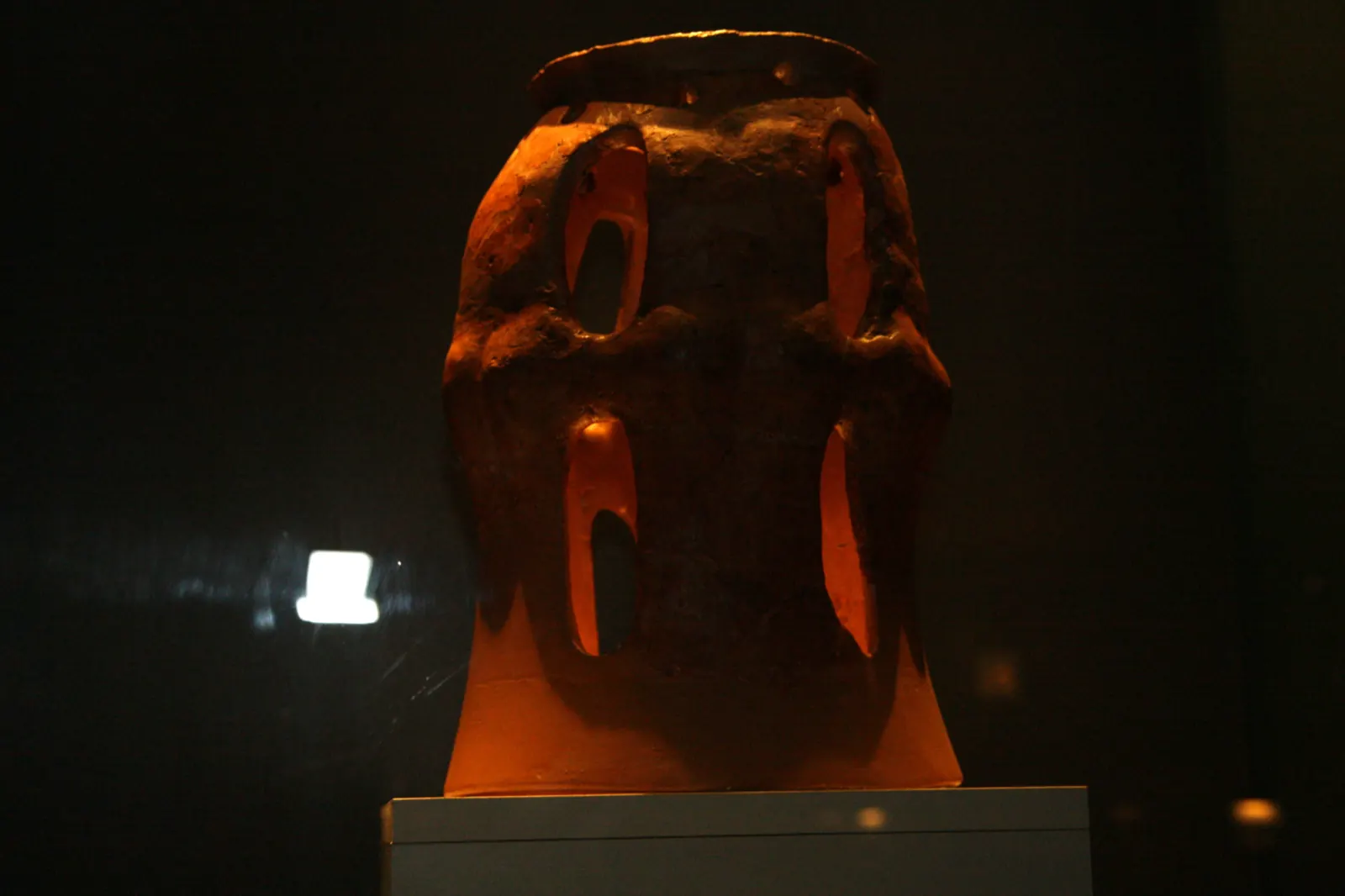
Here is the piece many consider the symbol of Cucuteni art: the Frumușica Round Dance. It was discovered in 1942 by Constantin Matasă on Cetățuia hill near Bodeștii de Jos, in Neamț County.
- Period
- Cucuteni A2, c. 4500–4350 î.Hr.
- Where it is
- Room 2: the painted vessels, ground floor
Read the textHide the text
Narration text
Here is the piece many consider the symbol of Cucuteni art: the Frumușica Round Dance. It was discovered in 1942 by Constantin Matasă on Cetățuia hill near Bodeștii de Jos, in Neamț County. It stands about 36 centimetres tall and was shaped roughly 6,400 years ago.
Look closely: there are six female figures, seen from behind, joined as if in a dance. The maker did not model heads, arms or legs. Only the hips remain, clearly marking them as women, and the oval openings arranged in two rows create a sense of movement, as though the dance were turning before our eyes.
Technically, it is a stand: another vessel probably rested on top of it, perhaps during a ritual. For Romanians the image has a special resonance, because the hora, the round dance, is still the dance that gathers a community into a circle. Perhaps this gesture of joined hands is far older than we ever imagined.